Inside the repair desk
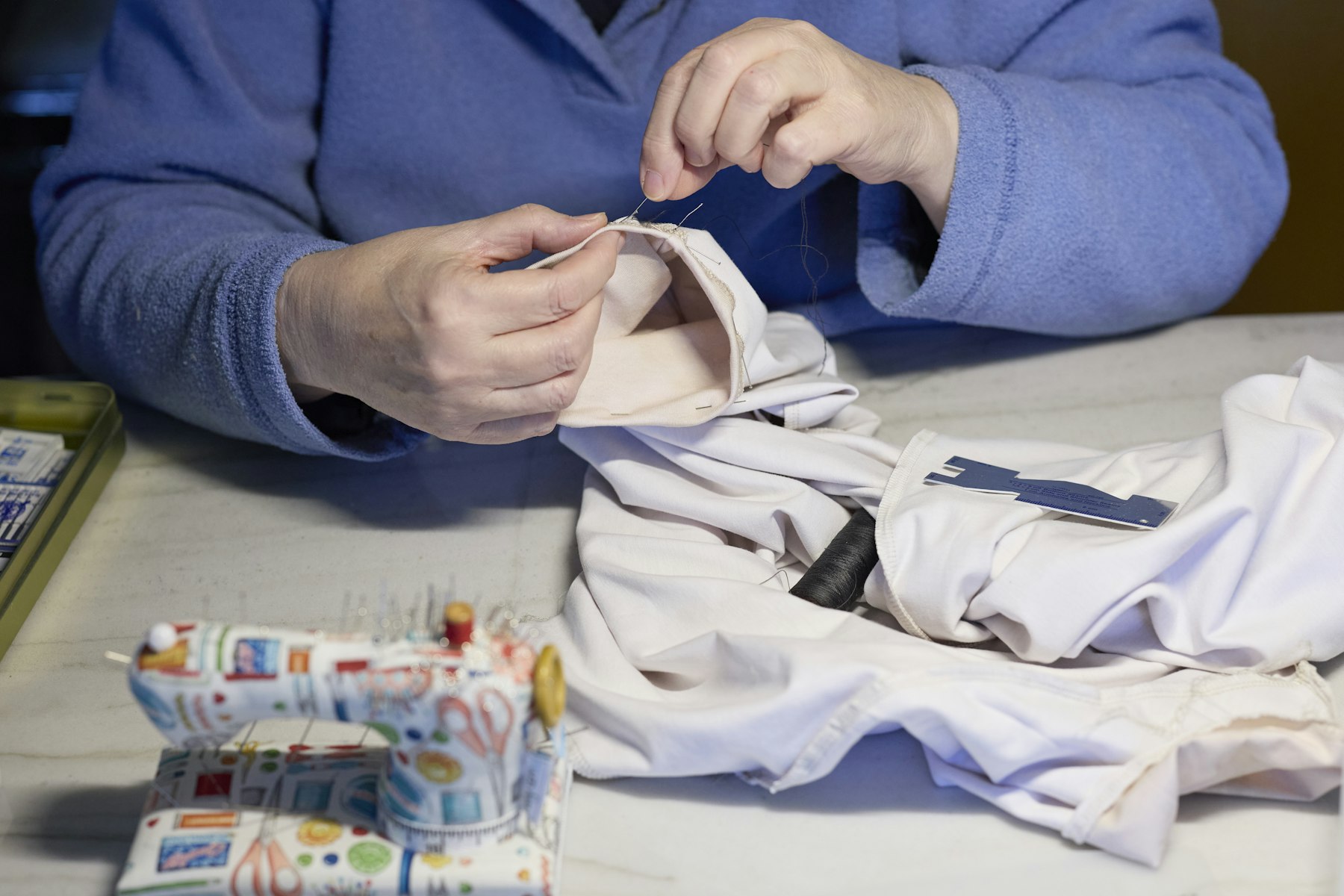
Every boutique has a repair desk. On an average Saturday in SoHo, it sees twenty pieces. I spent one of those Saturdays on a stool beside it, on the fourth floor of 112 Greene Street, watching what twenty pieces actually look like.
The desk is a long oak counter next to the atelier, with a steam iron, a button drawer of 140 compartments and a window that looks down on the cast-iron façade across the street. It is run on weekends by Ines Okafor, a tailor who trained on Savile Row before moving to New York, and her colleague Danny Ruiz, who handles intake.
10am: the first queue
The doors open at ten and by five past there are three people waiting with tote bags. The first is a man with a Waxed Cotton Field Jacket whose two-way zip has come off its track. Ines examines it, eases the slider back on with a pair of flat pliers, crimps the top stop and hands it back within four minutes. He had expected to leave it for a week.
Like most of the morning visitors, he lingered afterwards. The fourth floor is quieter than the shop below, and the desk has two stools for anyone who wants to watch. Ines does not mind an audience; she talks as she works, explaining why she is using a heavier thread or why a button needs a shank.
The second is a cashmere sweater with a moth hole at the cuff, which goes into a numbered bag for the Marylebone studio. Danny photographs it, notes the colour and the owner’s phone number, and explains that it will come back in about three weeks. The third is a missing button on a blazer, sewn on while the owner orders a flat white from the coffee bar downstairs.
What comes in
Loose buttons, broken zips and worn elbows, mostly. By my count, the day’s twenty broke down like this: seven buttons, four zips, three elbows or cuffs, two dropped hems, two seams, one torn coat pocket and one strap on a Structured Leather Tote whose stitching had started to lift.
Of the twenty, thirteen were fixed at the counter while their owners waited or browsed. Seven went into numbered bags for London, mostly knitwear needing matched yarn and the leather strap, which needs the cobbling bench’s saddle-stitching clamp.
1pm: the coat rush
The early afternoon belongs to coats. It is the first cold weekend of autumn and people are pulling them out of storage. A woman brings a camel wrap coat she bought in 2020; the inner tie has torn away from the side seam. Ines reinforces the seam with a small patch of matching wool on the inside and re-anchors the tie with a bar tack. Ten minutes.
Hems are the other autumn job. Every Apple & Ivey coat has a 5 cm hem allowance, and two people that afternoon wanted theirs let down, one because she had bought new boots with a higher shaft. Ines pins, measures, and books them in for Monday, when the atelier’s heavier machines are free.
The buttons are not the job. The job is the conversation. Somebody comes in with a coat they have worn for six years and they want to tell you about it. You listen, then you sew.
— Ines Okafor, tailor, SoHo repair desk
What it costs
Nothing, for any Apple & Ivey coat, for as long as you own it. That covers every job I saw on a coat that day, including a full replacement of a broken zip on a Quilted Liner Jacket. Knitwear repairs are free for Circle members, and other pieces are charged at cost, which for a button is usually nothing at all.
Not every visitor is an Apple & Ivey customer, either. A young woman brought a vintage tweed jacket from a flea market with a split lining, and Ines spent five minutes explaining how she could have it relined and roughly what it would cost elsewhere. She left with a business card for a tailor on Mott Street and, ten minutes later, a sweater from the floor below.
People often ask what happens if a piece is beyond the desk. Danny’s answer is that it rarely is. In the past year, he says, the SoHo desk has turned away only a handful of items, and each time with a suggestion of someone who could help.
6pm: closing the drawer
By closing the counter has the look of a busy kitchen. Ines sweeps thread ends into a jar that, once full, goes to a Brooklyn school for art projects. Danny reconciles his log, seven bags ready for Tuesday’s courier, and resets the button drawer. Twenty pieces, almost exactly the average.
What struck me most was how ordinary it all felt, in the best sense. Nobody made a speech about sustainability. People simply brought their clothes in and took them home again, ready for another winter. If yours need a hand, the desk is on the fourth floor, and the coats it looks after are made for exactly this.